Opinion Sur
A Thought for Hard Times
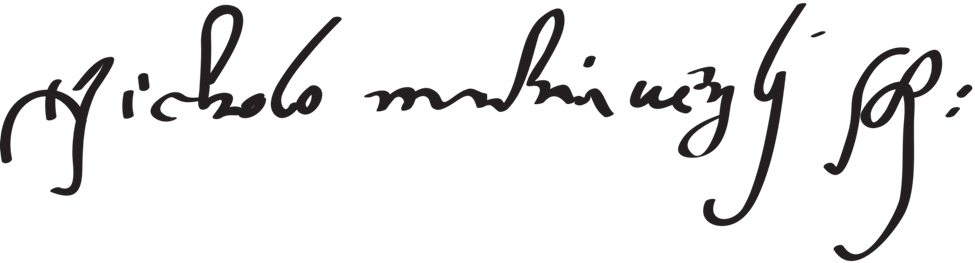
We are not in “normal times.” Who dares to think deeply about where we are and where we are going? Machiavelli posed the question like no other. His ghost continues to pose it.
___________________________________________________________________
In turbulent times, both within and between (self-absorbed and blind) countries, it is worth remembering Machiavelli’s thought. I use the proper noun and not the adjective because “Machiavellian” has always lent itself to misinterpretation. It is often used as an insult. Fortunately, serious historians and political scientists have managed to rescue this great Florentine from reproach[1].
Many years ago (1998), I had the amusing privilege of being allowed by the Florence major (sindaco) to spend an hour behind closed doors in Machiavelli’s studio inside the Palazzo Vecchio, which is normally off-limits to the public. Sitting at that desk, I began a reflection on his life and thought that I follow to this day as something more than a hobby.
In the 1980s and 1990s, I had the opportunity to investigate the use of fear as an exercise of power, in relation to the military dictatorships of the Southern Cone. Research on the “culture of fear” produced a collective volume entitled Fear at the Edge, which has been widely cited ever since. The project was initiated by the Argentinian political scientist Guillermo O’Donnell and I followed it with a group of social scientists sponsored by the Social Science Research Council of the United States. In that project, I had Niccolo Machiavelli as a silent and ghostly companion.
Machiavelli was the first thinker to confront the problem of politics, which was very turbulent in his time, in an empirical and ruthless way, abandoning the moralistic tradition of the “buon governo” and the elaboration of models of an ideal state, which dates back to Plato and Aristotle. His maxim was andare diretto alla verita effetuale della cosa, that is, to see things as they are and not as they should be. He was the founder of a realist policy that is known today in its German expression of Realpolitik. It is current today in the geopolitical thinking of well-known figures, such as Henry Kissinger and John Mearsheimer.
Machiavelli’s originality and current relevance can be summed up in a few questions that are guides to the analysis. Who is in charge? How does s/he exercise her/his mandate? Who is afraid of what?
In the Italian Renaissance, the first question usually had two answers: either the republic or the autocracy. The first was a municipal council with a head of state or high magistrate elected by the council – the gonfalonier. The second was the rule of the head (dictator) of a powerful family – in Florence, one of the Medici. In other words: either Republic or Principality. Sometimes, an episode of anarchy or confusion took place between the two models, which could lead to a coup d’état.
Machiavelli’s most famous book is precisely a practical and theoretical analysis of the way a principality is governed – in his case the accession to power of one of the Medici by a coup d’état, after a fairly long period dominated by a reformist religious agitator: the monk Savonarola. The book on principalities (De principatibus) ended up being called The Prince. It was written in the forced exile of Machiavelli, who had been secretary to the gonfalonier Soderini in a weak republic deposed by the Florentines. For an Argentinian reader, Machiavelli’s book is reminiscent of the text of General Perón’s booklet, Conducción política (Political Leadership), 1952, but it goes much further in the direction of a theory of power.
The Florentine had to navigate stormy seas. What was a personal misfortune for Machiavelli was a benefit to his posterity. As Borges said in another field, repression and censorship are bad for the writer but good for literature. He passed from advice and daily observation (his correspondence with friends is a valuable mine of commentary) to general reflection, at a considerable distance from the accidental conjuncture. He looked carefully at ancient history—especially Roman history—to draw valuable lessons from it. He also expressed his disenchantment with sarcasm and irony in other genres of writing: theater and poetry. Like Mozart in music three centuries later, he was able to play various instruments and composed works of different sizes, and all with mastery. In many ways, we can say that it is our contemporary. He found words to capture what was happening in spite of the hollow and used words of ordinary discourse. He was particularly attracted by ambiguity and surprise in social action, and by the unintended consequences of political activity.
To answer our second question, the vulgate immediately misquotes Machiavelli: “the end justifies the means.” But Machiavelli was well aware that the ends are not revealed until much later, and are often not those originally desired. I’ll give a “Machiavellian” example, with the advantage of the passage of time. The Argentine military dictatorship of the time (1976-1983) – calling itself the “National Reorganization Process” – which used terror as a means of social control, in turn feared losing all social support because of the poor management of the economy. To break the impasse, they embarked on a risky military adventure: the invasion of the Malvinas Islands (1982). It was a serious strategic mistake, as by then England was on the verge of scrapping its navy. The objective of recovering the islands could have been pursued through diplomatic means. The war provoked the opposite: the rearmament of the British fleet, which with American help (mistakenly the Argentine military thought it was not going to happen) attacked the invaders and defeated them in a short and bloody conflict. The unintended consequence was that the dictators fell from power and the country regained not the islands but democracy. It is a textbook case of the misapplication of means and ends, the exchange of fears and unintended consequences, in this case beneficial. For the geopolitics of the time, the conflict deserved the lapidary judgment of Jorge Luis Borges: two bald men fight over a comb. Another example is the U.S. invasion of Iraq (2003), which had the effect of geopolitically reinforcing its main enemy in the Middle East: Iran.
Given the above, Machiavelli would wonder how it is possible to exercise responsible politics. The answer was offered by none other than the founder of modern sociology–Max Weber–in a lecture he gave in Munich in 1919,[2] at the height of social upheaval after Germany’s defeat in the Great War. Weber wanted to serve as a guide based on intellectual work to young people who had just been relieved from military service and were deeply disturbed by the experiences of war and the post-war period[3]. In that lecture, he spoke to these young people about the situations that condition the politician and the psychological characteristics that a person must have in order to be considered a “politician by vocation”. Given his own circumstances, such a politician must weigh the various possible and likely consequences of his actions and think strategically about the future. Weber opposes such a “responsible” politician to the fanatic who only clings to absolute values and “ultimate ends,” without wanting to calculate the consequences (without a doubt he was thinking of a then-fashionable version of Nietzsche’s “will to power”).
Weber had another affinity with Machiavelli: he was a man of frustrated power. An attentive observer of German and world political life, Weber was a co-founder of the German Democratic Party. His time in politics was unsuccessful, but intense enough to capture the essence of human behavior in that context.[4] He accompanied the German delegation to the Versailles conference, where his country was forced to accept a punitive and disastrous peace that ended up provoking strong revanchism and ultimately facilitated the rise to power of National Socialism. Once again, we see a case of bad means producing unwanted and perverse ends, against the grain of the idealistic purposes of Woodrow Wilson and the absolutist arrogance of the European allies.
Machiavelli’s answer to our third question places us squarely before a political dilemma par excellence: persuade or intimidate? To be more precise: when should one or the other be used, both in the acquisition and in the maintenance of power? For Machiavelli, this is not a moral judgment, but a technical one. The two terms are related and the backdrop is always fear. Thomas Hobbes elaborated on his answer in his Leviathan. The struggle of all against all produces a strong demand for order: the constant fear of one’s neighbor leads to the collective desire to exchange it for the fear of all for one: e pluribus unum, which is the foundation of the State. Once the monopoly of intimidation is established, fear is removed from everyday life and presented only as a virtual threat (ultima ratio) that allows the development of other types of exchanges in the so-called public sphere. In later thinkers, the hope for a calmer world lies in commercial exchange and in a civic environment of competition and the composition of disputes with rules[5]. Political economy and democratic theory are born. But the ghost of Machiavelli warns that the republican peace as he lived and thought it is always fragile. (Today, we might add that commercial exchange is not enough to calm passions.) When a republic breaks down, fear comes back to the fore in the form of anarchy and despotism.
In “normal times” a skillful politician knows when and how to use the tricks of the fox (by composition) or the roar of the lion (by imposition). It is the simplest Machiavellianism. But with Machiavelli, normal times were the exception rather than the rule. In Italy, the alternation of foxes and lions was the inheritance Gaetano Mosca and Vilfredo Pareto received from Machiavelli. Today, there is an urgent need for an aggiornamento. Sooner or later nations and the world stumble and fall into a hellish reduction of politics to the binary logic of friend/foe, as the dark genius of Carl Schmitt thought.
Now, we are in that moment of fragility that such Florentine was able to understand and that we can call the sober bitterness of Niccolò Machiavelli.
[1] For those interested, I recommend reading Alexander Lee’s extensive biography, Machiavelli. His Life and Times, London: Picador, 2020. As another guide, I suggest Patrick Boucheron’s brilliant book, Machiavelli. The Art of Teaching People What to Fear, New York: Other Press, 2018. Original French Un été avec Machiavel (2017).
2. https://www.u-cursos.cl/facso/2015/2/PS01011/2/material_docente/bajar?id_material=1187931
3. See the excellent study by Wolfgang Schivelbush, The Culture of Defeat: On National Trauma, Mourning, and Recovery, New York and London: Picador, 2004.
[4] For an exercise in analysis and style similar to the Machiavelli of epistolary correspondence, I must cite Juan Carlos Torre’s wonderful book, Diary of a Season on the Fifth Floor. Episodes of economic policy in the Alfonsín years. Buenos Aires: Edhasa, 2021.
[5] Consider the great work by Albert O. Hirschman, The Passions and the Interests. Political Arguments for Capitalism Before its Triumph. New Jersey: Princeton Classics, 2013.
If you liked this text, you can subscribe by filling out the form that appears on this page to receive once a month a brief summary of the English Edition of Opinion Sur